Identification #
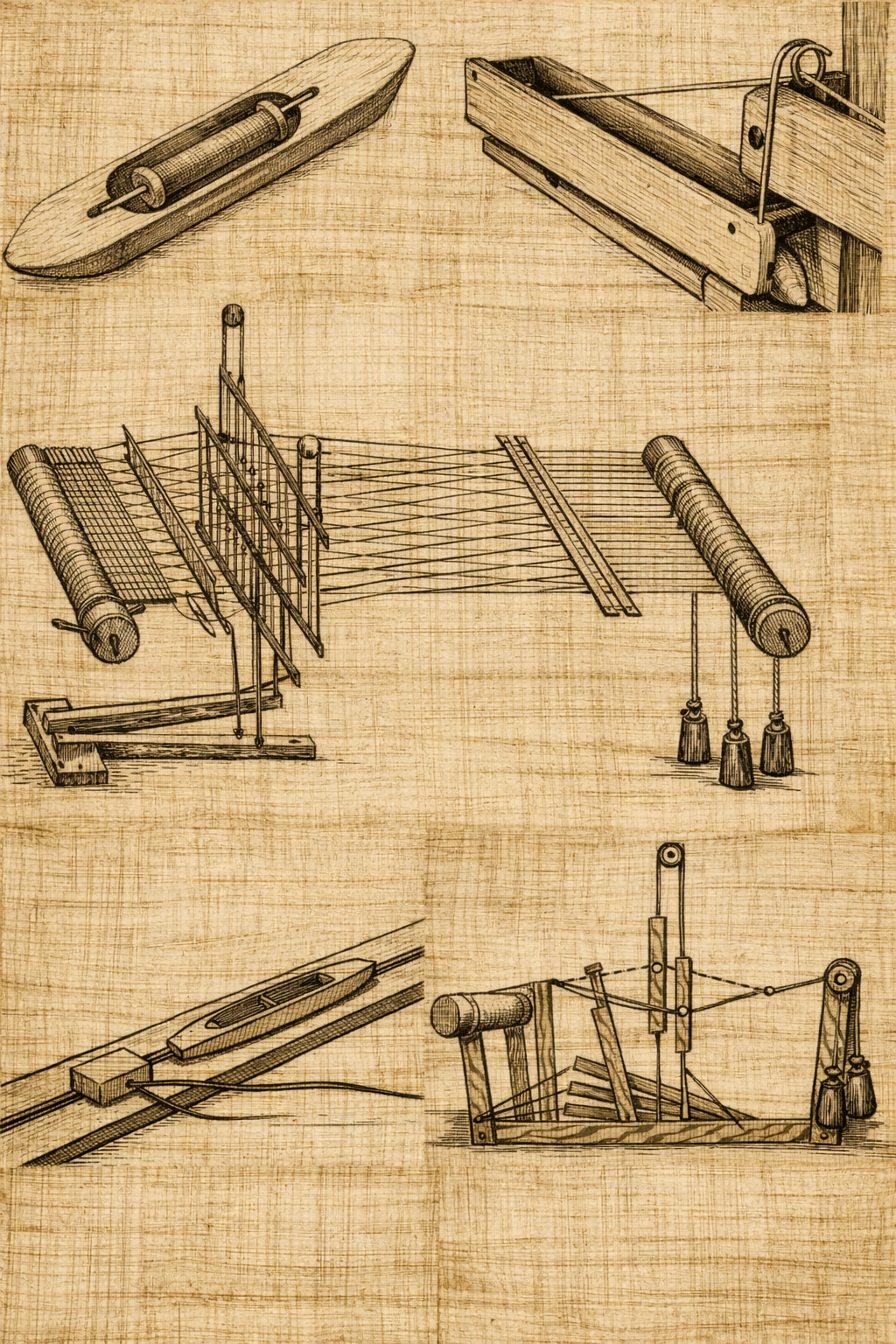
The Industrial Loom is a mechanized horizontal weaving machine introduced by the House of Gaius in late 79 AD. It represents the second stage of the Picentian textile revolution, designed to process the unprecedented volume of yarn produced by the Spinning Wheel.
Description #
Unlike the traditional Roman upright loom, the Picentian design is a horizontal machine that allows the weaver to operate seated. It utilizes a sophisticated system of heddles and shuttles that can be linked to external power sources (initially manual, later steam). Its construction is robust, using oak framing and iron components for high-tension weaving.
Provenance #
The blueprints were drafted by Lucia and Ulysses in the autumn of 79 AD after Marcus reported "mountains of yarn" piling up in Picentian warehouses. The transition from vertical to horizontal weaving was managed by the Lanifica.
Function/Operation #
- The Horizontal Shift: The move from standing to sitting weaving was a major social and technical concession to speed.
- Production Volume: Capable of producing finished cloth at five times the rate of a traditional loom.
- Tension Management: The use of iron weights and bronze gears allowed for consistent weave density across large bolts of cloth.
Scholarship/Variants #
The archives note that the Lanifica initially resisted the horizontal loom, viewing sitting as a "dignity-reducing" concession. However, the economic pressure of the Yarn Glut and the superior quality of the finished industrial cloth eventually forced its universal adoption.