Identification #
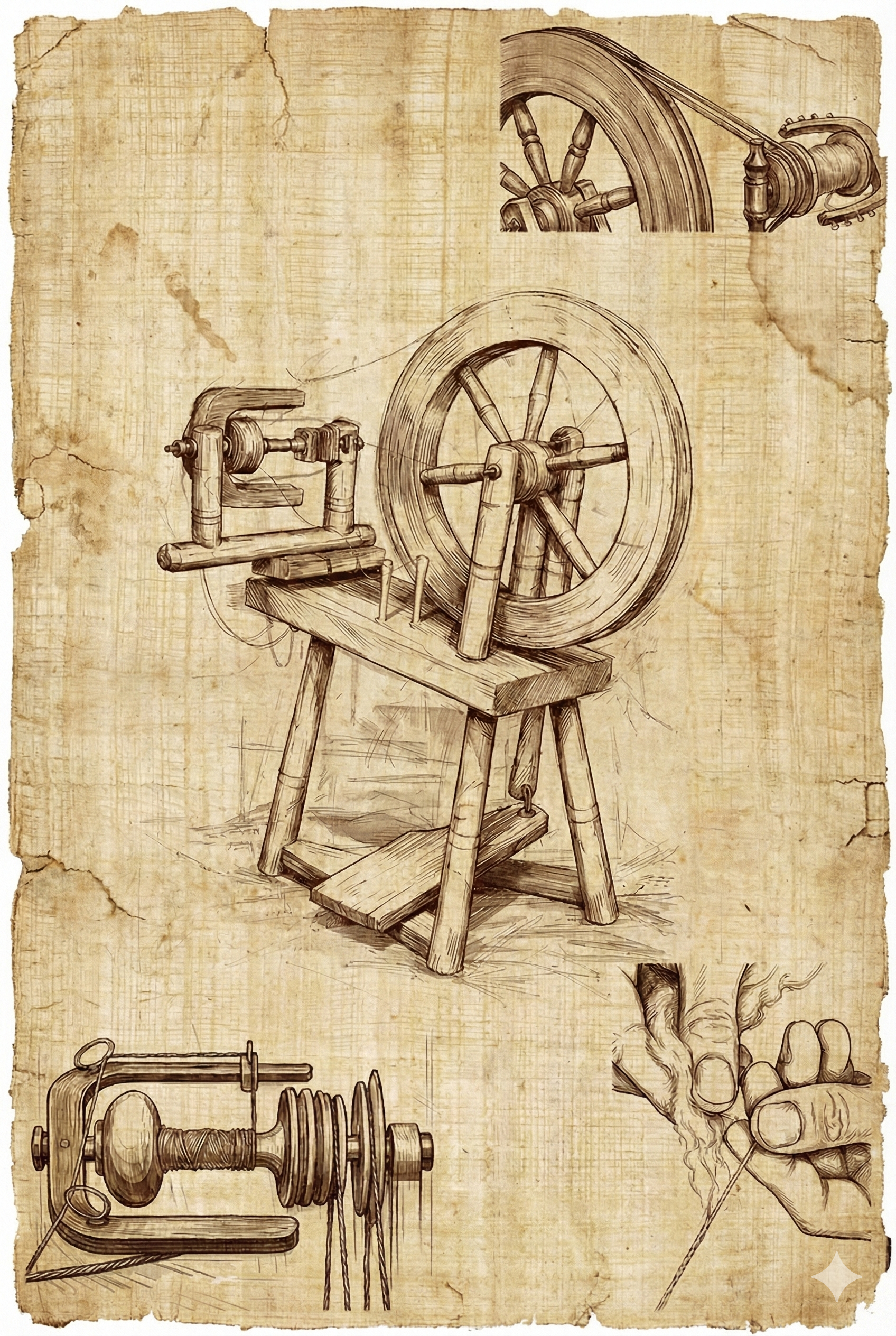
The Spinning Wheel, also known as the "Great Wheel" or "Picentian Wheel," was the first mechanical innovation introduced to ancient Rome via the Lydian Stone. It replaced the traditional drop spindle, which had remained largely unchanged for millennia.
Description #
The Picentian design is a hand-powered "Walking Wheel" constructed from local oak or pine. It features a large, light-weight spoked wheel (approximately 1 meter in diameter) and a dual-pulley spindle mechanism. Its key innovation is Differential Speed: the use of two pulleys on a single axis to allow the flyer to spin faster than the bobbin, creating simultaneous twist and winding tension without complex gearing.
Provenance #
The blueprints for the wheel were provided by Ulysses and Lucia in the spring of 79 AD to Marcus. The design was adapted for Roman materials and manufacturing techniques by the House of Gaius.
Function/Operation #
- Production Leap: Increased yarn output by 10x to 100x compared to manual drop-spinning.
- Drive System: A single drive band loops twice around the drive wheel and the two spindle pulleys.
- Tension Logic: The differential speed mechanism initially confused Roman engineers, who viewed the simultaneous twist-and-wind logic as "impossible" before seeing it in operation.
Scholarship/Variants #
The Lanifica initially viewed the machine as "vulgar" or even cursed, suspecting the "Evil Eye" due to its unnatural speed. However, the consistent quality of the industrial yarn eventually convinced them to adopt the technology and manage its large-scale deployment.