Identification #
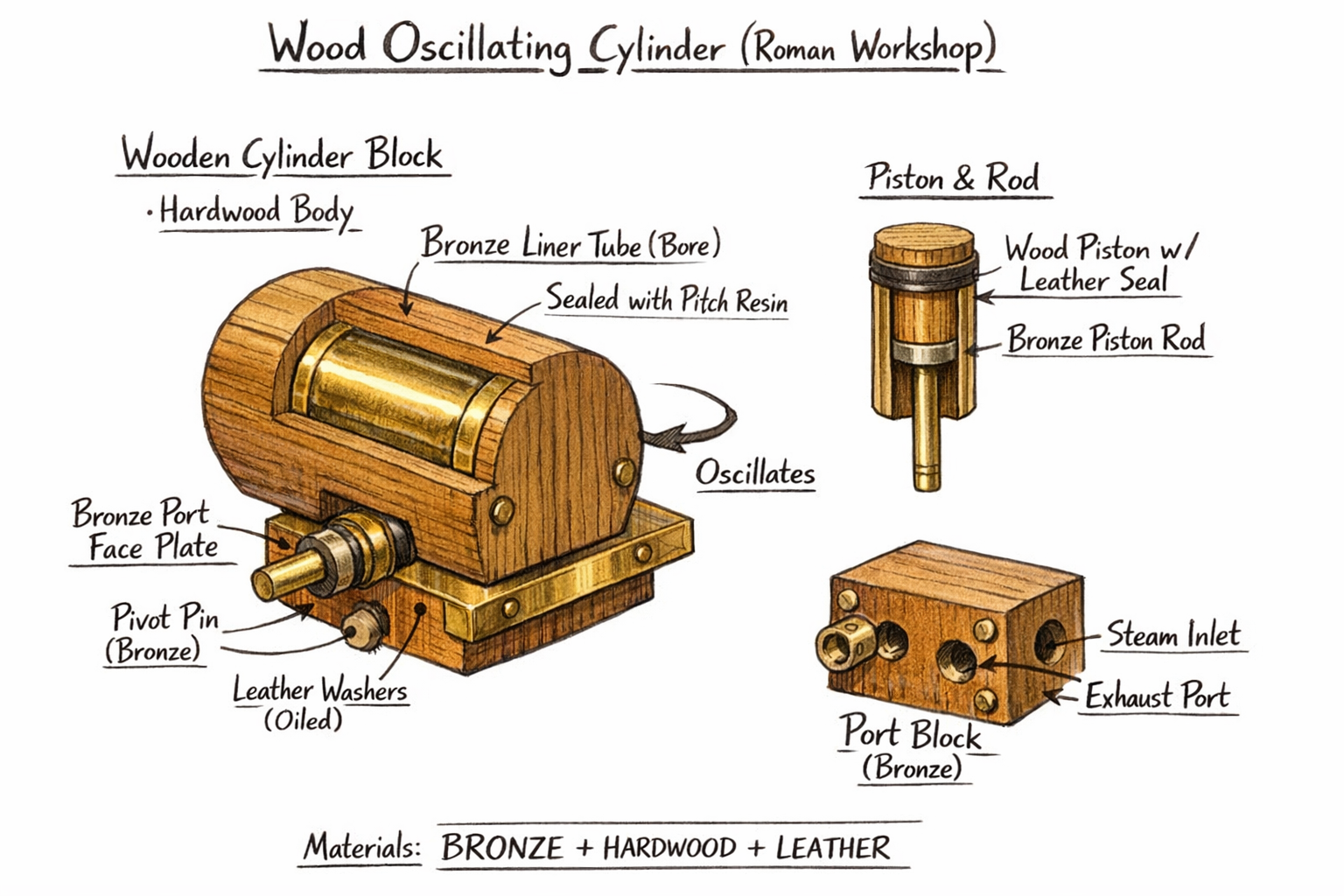
The Lydian Stone divergence utilized the oscillating-cylinder steam engine as its primary power source. Chosen for its mechanical simplicity, it avoided the need for complex valve systems, instead using the cylinder's own movement to alternate steam ports.
Description #
The engine consists of a bronze cylinder that rocks back and forth around a pivot (trunnion) as the crankshaft turns. This oscillation aligns ports in the cylinder face with matching holes on a fixed port block, alternately feeding live steam and venting exhaust. It is a robust, low-RPM machine characterized by high maintenance requirements but extreme relative power.
Roman Adaptation #
The engine was specifically designed to be manufactured using existing Roman techniques:
- Bronze Casting: For the cylinder and port blocks.
- Copper Piping: For steam transport.
- Leather Seals: For piston packing and trunnion gaskets.
- Lead/Charcoal: For furnace and boiler construction. The primary "leap" was in pressure boiler-making, transitioning from traditional Roman lead plumbing to riveted copper and bronze pressure vessels.
Function/Operation #
- Prototype (Class P): A bench engine (80–200 kg) producing 0.5–2 hp, used to power single looms or lathes.
- Loomhouse Engine (Class A): A massive installation (1–4 tons) producing 10–20 hp, driving a line shaft across an entire factory hall.
- Marine Engine (Class B): A large-scale unit (5–20 tons) producing 40–80 hp for paddle-wheel propulsion.
Scholarship/Variants #
The "Fire of Archimedes" was the intellectual framework used by Marcus to justify the danger of high-pressure boilers. The archives note that early engines were "temperamental animals," requiring constant oiling and regular lapping of the port faces to remain functional.