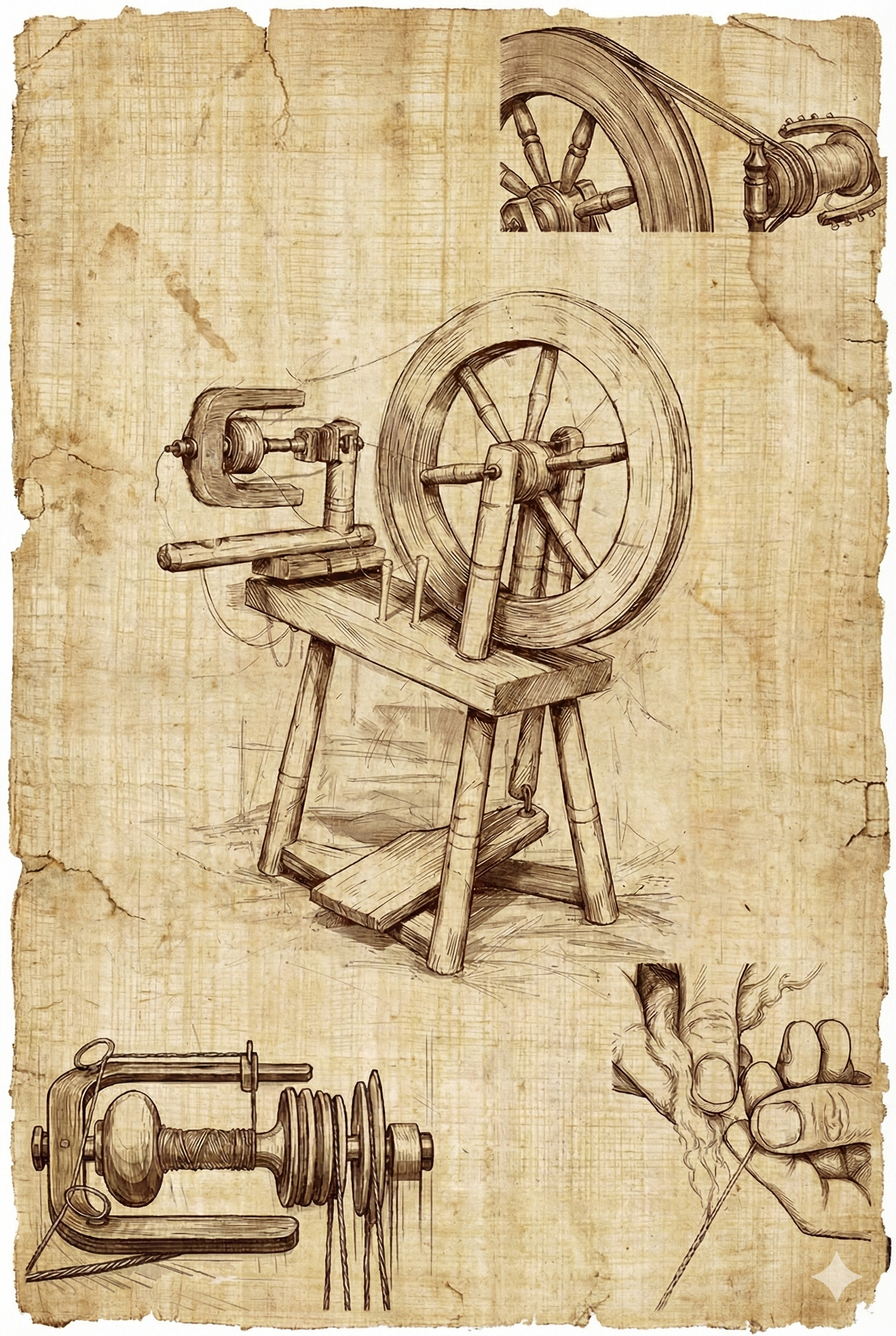
Editorial Note #
This text represents the modern transcription of the drawings and Latin instructions sent by Ulysses to Marcus on May 20, 79 AD. The original "interface" of the Lydian Stone produces glowing text that fades after five seconds, requiring Marcus to transcribe the information immediately onto wax tablets.
Text (Original Latin) #
Ulysses: Marcus, audi. Filum celerius facere possumus. Rota magna, axis unus, duo tympana. Unum parvum, unum magnum. Marcus: Quomodo? Una rota duo celeritates? Ulysses: Ita. Differentia celeritatis. Tympanum parvum celerius vertit. Filum torquet et volvit simul. Non est magia, est mechanica.
Translation (English) #
Ulysses: Marcus, listen. We can make thread faster. A large wheel, one axis, two pulleys. One small, one large. Marcus: How? One wheel, two speeds? Ulysses: Yes. Differential speed. The small pulley turns faster. It twists and winds the thread simultaneously. It is not magic, it is mechanics.
Commentary #
This exchange is critical as it marks the first time Ulysses attempted to "optimize" the past. The concept of Differential Speed—allowing two parts on the same axis to spin at different rates through pulley ratios—was the "impossible" logic that Marcus had to translate into functional Roman engineering. This transmission moved the House of Gaius from survival to industrial prosperity.
Provenance #
The modern record of this transmission exists in Ulysses' personal logs and the digital captures of the Stone's surface activity during the 2025 excavation.